
The Scope Section of a Men's Fragrance Brief: What to Write Down
Scope is the part of a fragrance brief that decides who does what, and it is usually the shortest section in the document — which is why projects drift. On a men's line, scope has to name the formula, the bottle, the closure, the carton, the filling, the testing and the documents, and say plainly which of them the manufacturer supplies and which the brand retains. Anything left unstated will be assumed in the direction of whoever is doing the work.
Key takeaways
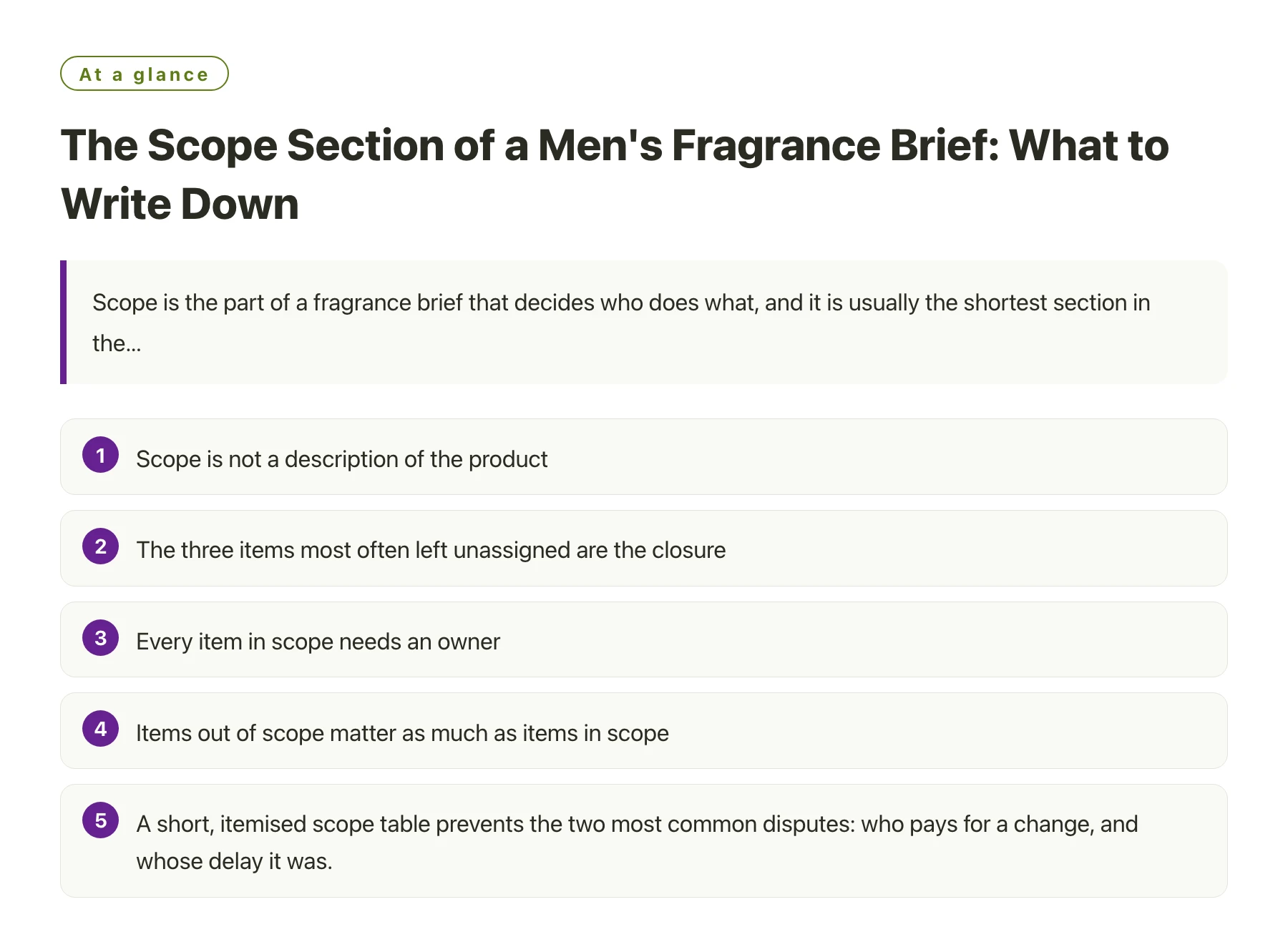
- Scope is not a description of the product; it is an assignment of responsibility for every deliverable in the project.
- The three items most often left unassigned are the closure, the outer carton and the artwork production file.
- Every item in scope needs an owner, a specification and a moment of approval, or it will be discovered late and expensively.
- Items out of scope matter as much as items in scope, because they are the ones the brand has to resource itself.
- A short, itemised scope table prevents the two most common disputes: who pays for a change, and whose delay it was.
Most briefs describe the product they want and leave the division of labour to be worked out during the quotation. That works when the two parties have done it before together, and fails predictably when they have not.
A scope section does not need to be long. One page with two columns — supplied by the manufacturer, supplied by the brand — removes the ambiguity that later becomes a schedule problem or an invoice.
The checklist below is written for a first men's fragrance line, where the brand is buying development and production but has not yet decided how far the partner's reach should extend.
The scope checklist, item by item
- Fragrance developmentWho briefs the perfumer, how many sampling rounds are included, who owns the formula, and what happens to rejected trials. Development is the first item because its outcome constrains everything downstream.
- Regulatory review of the formulaWho checks the approved formula against the use restrictions for the target product category, and at what point. Fragrance materials are governed by category-specific standards that set limits on individual ingredients [1], so this check has to happen before the formula is frozen, not after.
- Bottle and glassWho selects the mould or stock bottle, who holds the tooling, who pays for samples, and what the minimum order is per component. Glass is usually the longest lead item on a men's line.
- Closure, pump and collarThe most frequently unassigned item in the whole project. Name the supplier, the finish, the colour and the crimping specification, and state who approves the first article.
- Outer carton and printWho produces the dieline, who writes the copy, who checks the barcode and the allergen declaration, and who signs off the print proof. Cartons carry regulated information, so the approval route matters.
- Filling, crimping and assemblyWhether the partner fills and assembles the finished unit or ships components separately. If the brand assembles, the scope should say who is responsible for a leak or a misaligned label.
- Testing and stabilityWhich tests are run, by whom, at whose cost, and what the batch has to pass before release. Retained reference samples belong here too.
- Documents and export paperworkThe list of documents that travel with the goods, who prepares each, and which market obligations sit with the brand. Packaging and product rules in the destination market belong in this line rather than in a compliance appendix [2].
Reading a scope section back to find the gaps
Once the items are written down, the useful exercise is to read the list as a sequence and look for the handoffs. Every handoff is a place where a delay or a quality problem can be attributed to nobody, because both parties believed the other was watching.
There are three habitual gaps. The first sits between the formula and the pack: the brand approves a scent, the factory sources the bottle, and nobody has confirmed that the juice is compatible with the chosen liner and pump. The second sits between the artwork and the print: the brand supplies a design file, the factory prints, and nobody has checked the dieline against the bottle geometry. The third sits between production and shipping: the pallet is ready and the documents are not.
Give every gap a named owner
The fix is not to add more items but to add an owner to each handoff. Compatibility review, print proof approval and document readiness should each have a person responsible and a deadline that sits before the milestone they protect. This is the part of a brief that reads like housekeeping and behaves like insurance.
Decide how far the partner should reach
Scope also answers a commercial question: how much of the project do you want to manage yourself? Choosing a factory that handles fragrance R&D and production means fewer suppliers and fewer interfaces, at the cost of less freedom to shop each component. A private label fragrance production arrangement usually goes further still, with the partner supplying a library scent and the pack, which reduces development time but also reduces how distinctive the result can be. Neither is better in the abstract; the scope section is where the choice becomes explicit.
A useful way to test a draft scope: for every line, ask who would pay if that item were three weeks late. If the answer is unclear, the scope is not finished. The same test works for quality: if a batch of cartons arrives with the wrong allergen declaration, the scope should already say who checked it and when. Xuelei publishes its own service description on the Xuelei website, which is a reasonable example of how far a single partner's scope can extend — but the point of the exercise is to match that reach to your project rather than to adopt it wholesale. Buyers who map the full scope before the first call spend far less time reconciling expectations later.
Sources
- IFRA Standards Library (International Fragrance Association) —— The IFRA Standards Library lists the restrictions the fragrance industry applies to individual fragrance ingredients, based on safety assessments; it is the reference point for compliant fragrance formulation.
- European Commission: Packaging Waste and the PPWR —— EU rules on packaging and packaging waste, including the Packaging and Packaging Waste Regulation requirements on recyclability and design.
Frequently asked questions
How long should the scope section of a brief be?
One page is usually enough. What matters is that every deliverable has an owner, a specification and an approval moment. A long scope that never names an owner is less useful than a short one that does.
Should the scope cover marketing and branding work?
Usually not, but it should state where the boundary is. Naming the product, writing the copy and producing final artwork are normally brand tasks, while the technical print file, the dieline and the compliance data are often supplied by the manufacturer. Stating that split avoids a slow argument later.
What if the brand wants to supply its own bottle?
That is a common and workable arrangement, but it changes the scope in two places: compatibility testing with the formula and the closure, and responsibility for breakage or rejects. Both should be written down, including who pays for a batch of glass that does not pass inspection.
Who should own the packaging artwork compliance check?
The brand is responsible for what appears on the label, but the factory usually holds the formula data that the declaration depends on. The workable split is for the factory to supply the data and the brand to confirm the final wording, with a stated approval step before print.
Does a bigger scope always mean a better price?
It often reduces coordination cost and can lower the per-unit price on components, but it also removes your ability to compare each item separately. The scope section should record which items you deliberately consolidated and why, so the decision can be revisited at the next order.