
How Long 0.001 BTC Takes and Why the Answer Keeps Moving
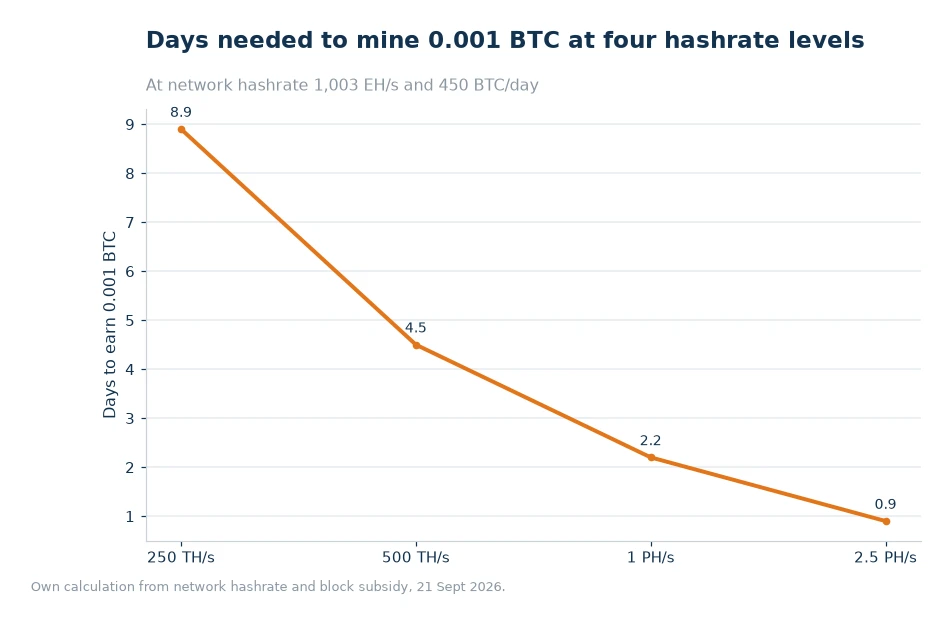
At 250 TH/s, one thousandth of a bitcoin takes about 8.9 days to mine. Double the hashrate and the wait halves to 4.5 days; ten times it and the wait is 0.9 days. The arithmetic behind those figures is fixed, but the figures themselves are not, because network hashrate and difficulty decide how much a terahash is worth. This is a guide to the timeline and to the two pool measures that make it wobble.
Key takeaways
- 250 TH/s mines 0.00011215 BTC a day, so 0.001 BTC takes 8.9 days at a network hashrate of 1,003 EH/s.
- At 2.5 PH/s the same target takes 0.9 days, because the wait scales inversely with hashrate.
- Pool hashrate shifts the size of the pool's slice; Pool Luck shifts how closely a short window matches the expected share.
- A −2.12% difficulty estimate would shorten every timeline by about 2.2%, which is small but repeats every adjustment.
The two numbers that set the timeline
Bitcoin pays 3.125 BTC per block and produces 144 blocks per day, so the network distributes 450 BTC daily. Your share of that is your hashrate divided by the network's hashrate. At 1,003 EH/s, which is 1,003,000,000 TH/s, each terahash is worth 0.00000044865 BTC a day. Multiply by your hashrate and you have a daily rate; divide your target by that rate and you have a timeline.
Nothing in that chain of reasoning involves luck, and that is deliberate. The calculation describes the long-run expected output, the average you would see across a very large number of days. Any single day, week or month can land above or below it. The gap between expectation and outcome is what pool operators measure as luck, and it is useful only if you know which question you are asking.
Pool hashrate versus network hashrate
Pool hashrate is the total pointed at one pool, and the ViaBTC BTC Mining Pool state page shows it beside the network total, which makes the comparison immediate. It matters because a pool finds blocks in proportion to its size, and a larger pool finds them more regularly, which smooths the arrival of PPLNS settlements. Network hashrate is the total pointed at Bitcoin everywhere, and it is the figure that appears in the payout formula. Confusing the two is the most common arithmetic error in mining spreadsheets: a pool holding 8% of the network does not pay you 8% more than the formula says, it simply finds one block in twelve.
The distinction becomes practical when a pool grows. As new hashrate joins a pool, existing miners keep their own machines and their own share of the network; what changes is the cadence of blocks found and the size of any single settlement. Daily expected income is untouched. That is why a miner can switch pools without changing the expected daily output, while the variance of the arrival schedule changes noticeably. On a small pool a single settlement can be dominated by one lucky block, and on a large one the same hashrate receives many smaller credits.
Pool luck, and what it does not do
Pool Luck compares blocks actually found with blocks expected over a window. A pool running at 105% luck found more blocks than its hashrate implied; at 95% it found fewer. Neither number is a verdict on the pool's engineering. Block discovery is a random process with a known average, and short windows scatter around that average by design. Over long windows the scatter narrows, which is why a month of poor luck says more about the calendar than about the operator.
For a PPS+ miner, Pool Luck does not change hourly income at all, because the block-reward component is settled against current difficulty rather than against blocks found. For a PPLNS miner it changes everything in the short run, since the payout waits for real blocks and shares out real rewards. Neither method makes luck disappear; they place it on different sides of the contract, and the choice between them is really a choice about who holds the variance while a round is open.
Timelines at four hashrate levels
The table turns the formula into a schedule. Each row uses the same daily rate per terahash, so the only variable is how many terahashes you control.
| Hashrate | BTC per day | Days to 0.001 BTC | BTC in 30 days |
|---|---|---|---|
| 250 TH/s | 0.00011215 | 8.9 | 0.0033645 |
| 500 TH/s | 0.00022433 | 4.5 | 0.0067299 |
| 1 PH/s | 0.00044865 | 2.2 | 0.0134595 |
| 2.5 PH/s | 0.00112163 | 0.9 | 0.0336488 |
Read the last column as a reality check on the days column. A miner at 250 TH/s who expects 0.001 BTC every nine days is also earning roughly 0.00336 BTC a month, which is a little over a third of a cent's worth of a bitcoin per day at $84,692. Small targets are reachable; they are just small. The table is not discouraging, it is dimensional.
Worked example
Take 250 TH/s and work the target arithmetic in full, then repeat it for the faster rows.
- Daily BTC per TH/s = 450 ÷ 1,003,000,000 = 0.00000044865.
- 250 × 0.00000044865 = 0.00011215 BTC per day.
- Divide the target by the daily rate: 0.001 ÷ 0.00011215 = 8.917 days, rounded to 8.9.
- At 500 TH/s: 0.00022433 BTC per day, and 0.001 ÷ 0.00022433 = 4.458 days, or 4.5.
- At 1 PH/s: 1,000 × 0.00000044865 = 0.00044865 BTC, and 0.001 ÷ 0.00044865 = 2.229 days, or 2.2.
- At 2.5 PH/s: 2,500 × 0.00000044865 = 0.00112163 BTC, and 0.001 ÷ 0.00112163 = 0.8916 days, or 0.9.
- In dollars, 0.001 BTC at $84,692 is $84.69, so the 8.9-day wait at 250 TH/s is a wait for about $84.69 of gross output.
Why the timeline slides after the fact
Every figure above is a snapshot of one difficulty. When difficulty rises, each terahash buys fewer coins and the days column stretches. When it falls, the opposite happens. The next adjustment was estimated at −2.12% on the read date, which would shorten these timelines by roughly 2.2% if it lands, so 8.9 days becomes about 8.7 and 4.5 becomes about 4.4. That is not a reason to replan a farm, but it is a reason to recalculate rather than assume.
Hardware efficiency sits outside this arithmetic entirely. A machine's joules per terahash decides whether the coins are worth having, not how many arrive. Two rigs at 250 TH/s produce the same 0.00011215 BTC a day and can have completely different power bills. Pair the timeline with a consumption figure before deciding the target is worth chasing, and remember that a machine which loses money at the current price does so at every hashrate level.
Frequently asked questions
Is 0.001 BTC a realistic first target?
At 250 TH/s it takes 8.9 days at current network hashrate, so it is a reasonable first milestone for a single modern rig; at 50 TH/s the same target takes over a month.
Does high pool luck mean I earn more?
Only under PPLNS, where real blocks and real rewards set the payout; under PPS+, hourly income tracks current difficulty and is unaffected by a lucky or unlucky run of blocks.
What if my pool's hashrate doubles?
Your daily expected output stays the same, because it depends on your share of the whole network; what changes is how often the pool finds blocks and how large each settlement is.
Recalculate on the day you commit
Timelines age quickly. Take the daily rate for your hashrate, divide the target by it, and write the result beside the date and the difficulty you used. The ViaBTC Statistics pages publish the current pool and network readings, so the next revision takes a minute. Treat the number as an estimate with a moving denominator, and no difficulty adjustment will arrive as a surprise.
Sources: the pool's state and statistics pages for Pool Hashrate, Pool Luck and network readings[1], plus chain data read 21 Sept 2026 — network hashrate 1,003 EH/s, difficulty 132.76 T, 3.125 BTC per block, 144 blocks a day, BTC $84,692 — published 22 Oct 2026. All day counts are arithmetic on those inputs.