
What Pool Fees Actually Cover: Orphan Blocks, Luck and Uptime
A pool fee is not a service charge for hashing; it pays for two things miners would otherwise carry themselves. The first is variance — pool luck and orphan-block outcomes. The second is uptime, and at 1 PH/s the second is worth more than most miners expect: two points of availability across a 720-hour month is 14.4 hours, which is $24.19 of gross income, almost exactly the difference between the listed 4% and 2% schedules on the same hashrate.

Key takeaways
- Two schedules, one price difference: at 1 PH/s the listed 4% block-reward charge is $48.47 a month against $24.23 for the 2% combined rate, a $24.23 gap.
- That gap buys risk transfer. Under PPS+ the miner absorbs neither pool luck nor orphan-block outcomes; under PPLNS both stay on the miner's statement.
- Uptime is priced on the same scale. One hour offline at 1 PH/s is $1.68, and 14.4 hours is $24.19 — within a dollar of the whole fee gap.
- The fee also lowers the power price you can afford: from $0.0841 to $0.0808 per kWh at 20 J/TH, a $0.0033 drop in headroom.
What the four-percent line buys
Look at what a miner's statement would contain without a pool. Blocks arrive at random intervals; some are found and then discarded because another chain tip won the race. Income therefore swings block to block, and a slow month is not a fault but the distribution doing its job. The listed 4% rate charged on the block reward that PPS+ settles is the price of moving those two outcomes off the miner's ledger, and the pool pays every hour at current difficulty regardless of whether it found anything that hour.
The alternative is cheaper on paper and not cheaper in practice: a single 2% charge across the block reward and transaction fees together, with payment after 6 confirmations and distribution across the last 5 difficulty rounds. The miner keeps every favourable outcome and also every unfavourable one, and the long-run average is usually the reward for carrying that.
Put dollars on the transfer. At 1 PH/s the block-reward income is 0.014206 BTC a month, or $1,211.68. The four-percent charge on that component is $48.47; the two-percent charge is $24.23. The $24.23 difference is what risk transfer costs per PH/s per month, and it is fixed — it does not swing with luck, which is the point of buying it.
Uptime is the second thing the fee covers. Pools maintain nodes, node failover, payout infrastructure and the monitoring that turns a dead worker into an alert rather than a week of silence. None of that is free, and none of it is visible in the fee percentage. What is visible is what its absence would cost you.
Pricing uptime against the fee
The measurement is simple because downtime has a known value per hour. At 1 PH/s, gross income runs at $1.68 an hour, so every hour of outage has a price and every availability percentage converts into dollars. Ninety-nine percent of 720 hours leaves 7.2 hours down, worth $12.10. Ninety-eight percent leaves 14.4 hours, worth $24.19. Ninety-seven percent leaves 21.6 hours, worth $36.29. Compare those against the $24.23 monthly fee difference and the ranking becomes clear: a two-point availability gap between two options outweighs the entire difference between their fee schedules.
That is the argument for treating uptime as the first column of any pool comparison and the fee as the second. A schedule that looks a percent cheaper is not cheaper if it costs half a percent more of your fleet's online time, and at 10 PH/s every one of these numbers multiplies by ten.
| Element | Value at 1 PH/s | Who carries it under each mode |
|---|---|---|
| Pool luck and orphan blocks | $24.23 a month of risk transfer | PPS+ takes it, PPLNS leaves it with the miner |
| One hour of downtime | $1.68 of gross income | The miner, in both modes, unless a farm contract says otherwise |
| 98% monthly availability | 14.4 hours, $24.19 | The miner; it consumes the entire fee difference |
| Breakeven power price | $0.0841 per kWh gross, $0.0808 after the fee | The fee narrows the power headroom by $0.0033 per kWh |
| Payout handling | Hourly credits versus payment after confirmations | Determines when income appears, not the total |
| Monitoring and node failover | Per-machine hashrate and alerting | Operational cost the fee funds either way |
Worked example: the same month, two ways
Take 1 PH/s for 30 days and build both scenarios from the same gross figure. Gross income is 0.014206 BTC, or $1,211.68. In the first scenario the schedule charges 4% on the block-reward component, $48.47, and the fleet runs at 99% availability, losing 7.2 hours worth $12.10. Landing figure: $1,151.11. In the second scenario the schedule charges 2% on both components together, $24.23, and the fleet runs at 97% availability, losing 21.6 hours worth $36.29. Landing figure: $1,151.16.
Five cents apart. A two-percentage-point difference in uptime cancels the entire fee-rate difference, which is the single most useful arithmetic in pool selection. The fee is a known, published, fixed cost; uptime is the cost that varies and the one that deserves the interrogation. Ask for the last twelve months of availability rather than a target, and ask what the operator counts as downtime — a worker reporting zero hashrate with an unplugged cable counts.
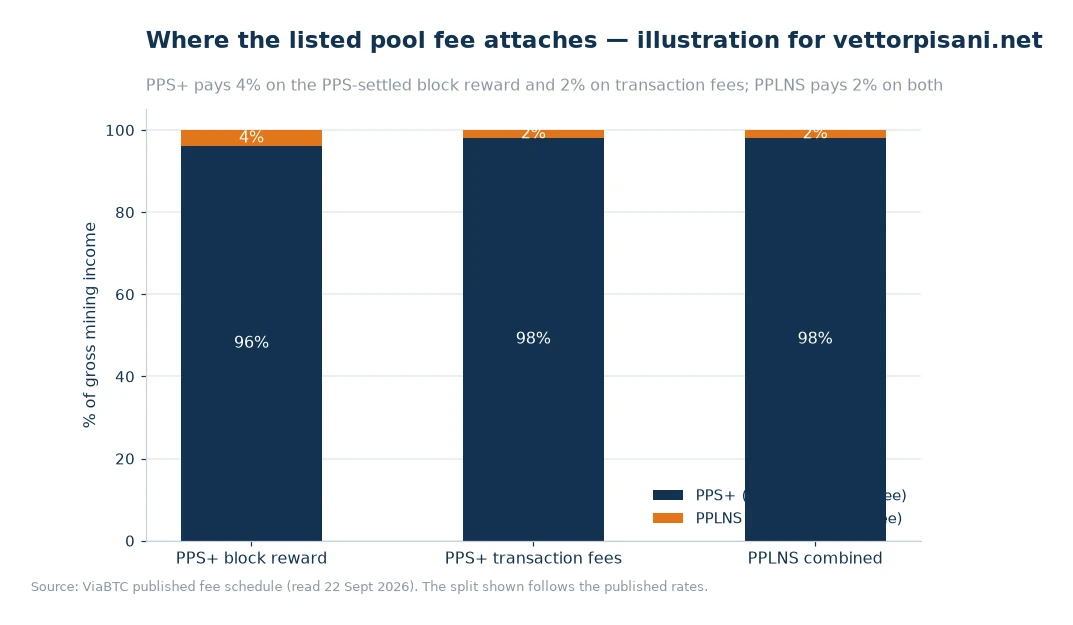
The chart also shows why the transaction-fee component rarely decides anything: it is excluded from these projections because it swings block by block, while the block-reward line covers the bulk of income at current difficulty. A miner comparing two schedules should compare the component that carries the money and then ask separately who absorbs the variability on the smaller one.
Where to read the extra-territorial risk
Two more items belong on the list because they are the ones miners discover late. First, a pool's own operational record: how often its pool hashrate moves unexpectedly, because that is where outages show up before any status page does. Second, the payout history: a credited balance is not a settled one until it is withdrawn, so the pool statistics view is worth checking whenever the schedule is being renegotiated. The component-by-component list of the ViaBTC Pool Fees is the reference for what each rate is applied to, and reading it next to your own uptime record is the fastest way to see which of the two is actually costing you money.
Frequently asked questions
Does PPS+ really remove orphan-block risk?
That is what the higher component rate is for. PPS+ settles the block reward on a per-share basis and pays hourly at current difficulty, so a block found and then discarded does not change the miner's income. PPLNS pays from the blocks that survive, which is why its single 2% rate is lower.
How much is one day of downtime worth at scale?
At 1 PH/s a full day offline is $40.39 of gross income, and at 10 PH/s it is $403.89. Divide by 24 and the hourly figure is $1.68 and $16.80, which is the number to hold against any maintenance window an operator proposes.
Should the fee or the uptime record decide a pool choice?
Uptime, at current numbers. The whole gap between the listed 4% and 2% schedules is $24.23 per PH/s per month, while two points of availability on 720 hours costs $24.19. A schedule is only cheaper if the hashrate reaches it consistently.
Audit the two lines, not the rate
Keep two records side by side: the fee charged each month against the published schedule, and the hours offline computed from your own per-machine hashrate. When those two columns are accurate, the choice between payout methods becomes an explicit trade — $24.23 a month per PH/s for the removal of luck and orphan risk, priced against the availability the operator actually delivers. Rebuild both columns after each difficulty adjustment, because the current estimate of +1.90% changes the value of downtime along with everything else, and the arithmetic you did last quarter no longer describes this one.
Data and sources: ViaBTC listed fee schedule[1] and pool state reporting[2]. Network difficulty (132.76 T), implied network hashrate (950.3 EH/s), the 1.90% next-adjustment estimate and the BTC price of $85,294 were read 22 Sept 2026. Uptime and fee figures are arithmetic on those inputs and are not a promise of earnings.